
Whether you are walking along the Eastbourne seafront, catching up with friends in a busy cafe, or simply If you have been noticing that conversations are harder to follow, or that you are turning the television up louder than you used to, you are certainly not alone. Millions of adults across the UK experience some degree of hearing loss, and for many, the idea of wearing a visible hearing aid can feel daunting. That is exactly where invisible hearing aids come in. Designed to sit deep within the ear canal, these small hearing aids offer a discreet solution that many people find appealing.
But are invisible hearing aids suitable for mild or moderate hearing loss? In this guide, we will walk you through everything you need to know about hidden hearing aids, the different types available, who they work best for, and how to decide whether they are the right choice for you. At Sussex Audiology Centre, we are passionate about helping people across Sussex find the perfect hearing solution, and we are here to make the process as simple and stress-free as possible.
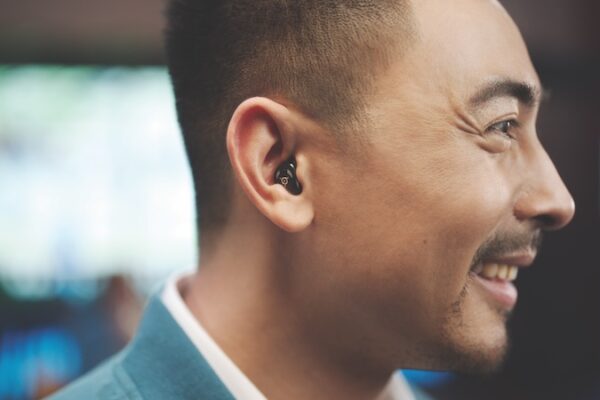
Invisible hearing aids are among the smallest hearing aids available today. They are custom-made devices that fit deep inside the ear canal, making them virtually undetectable to others. The most common type is the invisible-in-the-canal (IIC) hearing aid, which is designed to sit further inside the ear than other in ear hearing aids.
Because they are positioned so deeply within the ear canal, IIC hearing aids are often considered the closest thing to a truly 100% invisible hearing aid. According to the NHS, completely-in-the-canal (CIC) and invisible-in-the-canal (IIC) hearing aids are the smallest types available and fit further into the opening of the ear than other styles.
At Sussex Audiology Centre, we offer a full range of hearing aid styles, including IIC, CIC, and other discreet options. Our team will help you understand the differences so you can make an informed decision that works for your hearing needs and your lifestyle.
Before we look at whether invisible hearing aids are the right fit, it is helpful to understand what mild and moderate hearing loss actually means.
Mild hearing loss is generally classified as a hearing threshold of around 21 to 40 decibels (dB). If you have mild hearing loss, you may find it difficult to hear soft speech, whispered conversations, or sounds in noisy environments. You might notice that you miss parts of conversations, especially when there is background noise.
Moderate hearing loss typically falls within the range of 41 to 70 dB. At this level, you may struggle to hear normal conversational speech without some form of amplification. Everyday activities like phone calls, group discussions, and watching television can become noticeably more challenging.
Both levels of hearing loss can benefit significantly from the right hearing aids. A professional hearing assessment is the best way to determine the exact degree of your hearing loss and which type of device will serve you best. At Sussex Audiology Centre, we offer free hearing aid assessments, so there is no cost to getting started.
The short answer is yes. Invisible hearing aids are generally well suited for people with mild to moderate hearing loss. IIC hearing aids are specifically designed to provide the amplification needed for these levels of hearing difficulty, and their deep placement within the ear canal also offers a more natural listening experience for many users.
On our hearing aid styles page, we note that IIC devices are suitable for mild to moderate hearing loss and are available from multiple manufacturers with various control options. They are custom made to sit deep within the ear, making them an excellent choice if discretion is a priority.
However, it is worth noting that invisible hearing aids are not usually powerful enough for people with severe or profound hearing loss. If your hearing loss goes beyond the moderate range, other styles such as receiver-in-the-canal (RIC) or behind-the-ear (BTE) hearing aids may be more appropriate. Our audiologists will always guide you towards the most effective solution during your assessment.
When people search for the best invisible hearing aids, they often encounter several different styles. Understanding the differences can help you work out which option is right for you.
IIC hearing aids are the smallest and most discreet option available. They are custom-moulded to fit your ear canal and sit deep enough that they are virtually hidden from view. These devices are ideal for mild to moderate hearing loss and offer a natural sound quality thanks to their position close to the eardrum. They are not advised for those with particularly narrow ear canals or for people who are prone to ear infections.
CIC hearing aids are slightly larger than IIC devices but still offer an impressively discreet fit. They can be custom made and are suitable for moderate to severe hearing loss, making them a versatile option for a wider range of hearing needs. Most CIC models include remote control functionality, and some offer wireless compatibility.
ITE hearing aids are larger than CIC models, which makes them easier to handle for people with dexterity concerns. They can also carry a larger battery with a longer life. ITE devices are suitable for moderate to severe hearing loss and are available with remote control and wireless options.
While not technically invisible, RIC hearing aids are among the most popular discreet hearing aids on the market. A small housing sits behind the ear, connected by a thin wire to a speaker inside the ear canal. They are suitable for mild to severe hearing loss, and many models include Bluetooth streaming and rechargeable batteries, features that are often unavailable in smaller IIC or CIC devices.
You can explore all of these options in more detail on our hearing aid styles page.
Invisible hearing aids offer some wonderful benefits, but like any technology, they come with certain trade-offs that are worth considering.
On the positive side, in ear hearing aids like IIC and CIC models provide excellent cosmetic appeal. They are custom fitted to your ear anatomy, which often means a comfortable and secure fit. Their position deep in the ear canal can also reduce wind noise and provide a more natural sound, which many users prefer.
However, due to their compact size, invisible hearing aids may lack some of the advanced features found in larger devices. For instance, many IIC hearing aids do not currently support Bluetooth streaming or rechargeable batteries. The smaller size also means the batteries tend to have a shorter lifespan, and the devices can be more fiddly to insert and remove, particularly for those with limited dexterity.
If advanced connectivity features are important to you, a discreet RIC hearing aid may offer the best of both worlds, combining a low-profile design with modern wireless capabilities. During your hearing assessment, we will discuss all of these factors with you so that you can weigh up what matters most for your daily life.
Choosing a hearing aid is a very personal decision, and there is no single answer that works for everyone. Here are some of the key factors to think about when deciding between invisible hearing aids and other discreet options.
Your degree of hearing loss is the most important starting point. If you have mild hearing loss or mild to moderate hearing loss, IIC hearing aids are likely to be a strong option. For moderate hearing loss that sits at the higher end of the range, a CIC or RIC device might provide more effective amplification.
Lifestyle and daily activities also play a big role. If you spend a lot of time on phone calls or enjoy streaming music directly to your hearing aids, a Bluetooth-enabled RIC model might be a better fit than a smaller IIC device. On the other hand, if discretion is your top priority and your hearing loss is within the mild to moderate range, an invisible hearing aid could be exactly what you need.
Comfort and handling are equally important. If you have any concerns about dexterity or find it difficult to manage very small objects, it may be worth considering a slightly larger style that is easier to insert and remove.
At Sussex Audiology Centre, we take the time to understand your hearing needs, lifestyle, and preferences before making any recommendations. As a family-run business, we pride ourselves on a personalised, friendly service, and you are in good hands with us. You do not need a referral to book with us; you can book directly at one of our clinics across Sussex, including Hove, Haywards Heath, Lewes, Eastbourne, Goring-by-Sea, Ferring, and Storrington. We also offer home visits for those who are unable to visit us in person.
The demand for invisible hearing aids in the UK has grown considerably in recent years. Advances in technology mean that today’s small hearing aids are more powerful, more comfortable, and more reliable than ever before. Manufacturers such as Phonak, Starkey, Signia, and Widex all produce excellent IIC and CIC models, and we work with all of these leading brands at Sussex Audiology Centre to ensure you have access to the very best options.
With greater awareness around hearing health and the importance of early intervention, more people are seeking out hearing aids for mild hearing loss rather than waiting until the problem becomes more pronounced. The NHS recommends getting hearing aids as early as possible, noting that the earlier you get them, the more benefit you will experience.
If you have been putting off addressing your hearing concerns because you are worried about the appearance of a hearing aid, invisible and discreet options could be the ideal solution. There really has never been a better time to take that first step.
Whether you are experiencing mild hearing loss or moderate hearing loss, there is a hearing aid out there that can make a real difference to your quality of life without anyone else even knowing you are wearing it. Invisible hearing aids and other discreet styles have transformed the way people think about hearing care, and we would love to help you find the perfect fit.
At Sussex Audiology Centre, during your hearing aid assessment, our audiologist will take a full health history and complete a thorough hearing test. The assessment will conclude with the audiologist discussing what they feel is the most suitable corrective action and how they can best enhance your quality of life in your most challenged listening environments.
We offer hearing aid packages to suit different needs and budgets, along with ongoing patient aftercare to ensure your devices continue to work perfectly for years to come.
Yes, invisible hearing aids such as IIC models are specifically designed for people with mild hearing loss. They provide enough amplification to help you hear soft speech and everyday sounds more clearly, all while remaining virtually undetectable.
In most cases, yes. IIC hearing aids can work well for mild to moderate hearing loss. If your hearing loss sits at the higher end of the moderate range, your audiologist may recommend a CIC or RIC device for more effective amplification.
Most IIC hearing aids do not currently support Bluetooth streaming due to their very small size. If Bluetooth connectivity is important to you, a discreet RIC hearing aid is likely to be a better option, as these models often include wireless streaming and rechargeable batteries.
Battery life varies depending on the manufacturer and the amount of daily use, but IIC hearing aid batteries typically last between five and ten days. Because the batteries are very small, some users prefer to keep spares on hand for convenience.
Because they are so small, IIC hearing aids can be a little fiddly to insert and remove at first. However, most people become comfortable with the process after a short adjustment period. If dexterity is a concern, our audiologists can discuss alternative styles that are easier to handle.
The best way to find out is to have a professional hearing assessment. At Sussex Audiology Centre, we offer free hearing aid assessments where our audiologists will evaluate your hearing, discuss your lifestyle, and recommend the most suitable device for your needs.
If you are considering invisible hearing aids or simply want to explore your options for hearing aids for mild to moderate hearing loss, we would love to hear from you. Our friendly, expert team at Sussex Audiology Centre is here to guide you every step of the way.
You can get in touch by emailing us at info@sussexaudiologycentre.co.uk or by visiting our contact page to book your free hearing aid assessment. With clinics across Sussex and the option for home visits, getting the care you deserve has never been easier. We look forward to helping you hear the world more clearly.
8 April 2026

22 January 2024

3 March 2026
Fields marked with an * are required


© 2026 Sussex Audiology | Privacy Policy | Late Fees