
If you have been putting off booking a hearing test, you are certainly not alone. Many people across Lewes and East Sussex wait years before seeking professional advice about their hearing, often because they are unsure of what the process involves or whether their concerns are significant enough to warrant an appointment. The truth is, understanding your hearing health is one of the most proactive things you can do for your overall wellbeing.
At Sussex Audiology Centre, we are a family-founded and family-run hearing care provider, and we understand that taking that first step can feel a little daunting. That is exactly why we have put together this guide. Whether you have noticed subtle changes in your hearing or a loved one has suggested you get checked, this article will walk you through everything you can expect from a hearing assessment at our Lewes clinic, so there are no surprises on the day.
Hearing loss rarely arrives overnight. For most adults, it develops gradually over months or years, which means it can be easy to overlook or dismiss. You might find yourself turning the television up a little louder, asking people to repeat themselves more frequently, or struggling to follow conversations in busy environments like pubs or restaurants.
These everyday experiences are actually some of the most common signs you need a hearing test. According to RNID, the UK’s national hearing loss charity, signs of gradual hearing loss include difficulty following conversation in noisier settings and needing to increase the volume on devices beyond what others find comfortable.
Beyond the day-to-day inconvenience, there is growing evidence that untreated hearing loss can have wider health implications. Research from Johns Hopkins Medicine has found links between hearing loss and an increased risk of cognitive decline and dementia, particularly when hearing difficulties go unaddressed for extended periods. Early detection through regular hearing screenings can make a real difference to your long-term quality of life.
Knowing when to get a hearing test is not always straightforward. There is no single trigger that applies to everyone, but there are several situations where booking an appointment with an audiologist is a sensible idea.
You should consider a hearing test if you:
RNID reports that over half the population aged 55 or more have some degree of hearing loss, making age one of the most significant risk factors. Even if your hearing seems fine, a baseline test can be incredibly helpful for monitoring any future changes.
At Sussex Audiology Centre, you do not need a referral to book a hearing test. You can simply get in touch with us directly and we will arrange an appointment at our Lewes clinic at a time that suits you.
One of the biggest reasons people delay booking a hearing test is uncertainty about what it involves. We want to reassure you that the entire process is comfortable, straightforward, and completely painless. Here is a step-by-step look at what happens during a typical hearing assessment at our practice.
Every appointment begins with a friendly conversation. Your audiologist will ask about your general health history, any medications you take, and your specific hearing concerns. This is your opportunity to share what you have been experiencing, whether that is difficulty hearing speech, trouble in noisy environments, or symptoms like tinnitus.
We will also ask about your lifestyle and the types of listening environments you encounter day to day. This information helps us build a full picture of your hearing needs and is an essential part of providing personalised care.
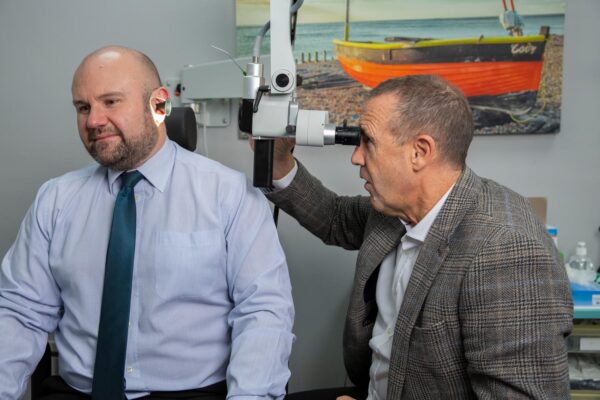
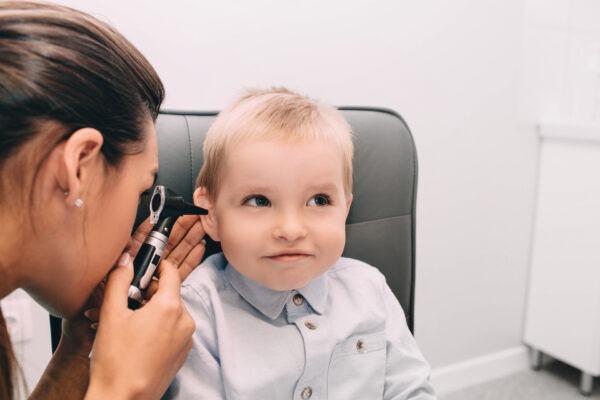
Before any tests begin, your audiologist will carry out a physical examination of your ears using an otoscope. This is a small handheld instrument with a light that allows us to look into your ear canal and check the condition of your eardrum.
This quick check helps us identify any obvious issues such as earwax buildup, signs of infection, or structural concerns that could be affecting your hearing. If earwax is present and is blocking the ear canal, we may recommend ear wax removal before proceeding with the full hearing test, as a blockage can influence the accuracy of your results.
Pure-tone audiometry is the core component of most adult hearing tests. During this test, you will wear a set of headphones and listen to a series of tones played at different frequencies and volumes. Each time you hear a sound, you will press a button or raise your hand to indicate that you have heard it.
This test measures the quietest sounds you can detect across a range of pitches, from low bass tones to high-pitched sounds. The results are plotted on a graph called an audiogram, which gives your audiologist a clear and detailed view of your hearing ability in each ear.
Pure-tone audiometry is entirely painless and typically takes only a few minutes per ear. It is carried out in a quiet, controlled environment to ensure the most accurate results.
While pure-tone audiometry tells us about your ability to detect sounds, speech audiometry assesses how well you understand speech. During this part of the test, you will listen to a series of words or sentences played through headphones at various volume levels and be asked to repeat what you hear.
This test is particularly useful because it reflects real-world listening situations. It helps us understand how your hearing loss, if present, may be affecting your ability to communicate in everyday life, something that a tone-based test alone cannot fully capture.
In some cases, your audiologist may also carry out tympanometry. This is a quick and painless test that measures how well your eardrum and middle ear are functioning. A small probe is placed gently in the ear canal, and a light change in air pressure is applied. The device then records how your eardrum responds.
Tympanometry can help identify issues such as fluid behind the eardrum, middle ear infections, or problems with the tiny bones in the middle ear. It is a valuable diagnostic tool that provides additional context alongside your audiometry results.
You can learn more about the different audio tests we offer on our website.
A complete hearing assessment at Sussex Audiology Centre typically takes between 30 minutes and one hour. The exact duration depends on the tests carried out and whether there is a need for additional discussion about your results and next steps. We never rush our appointments because we believe that thorough, personalised care leads to the best outcomes for our patients.
Once your tests are complete, your audiologist will take the time to explain your results clearly and in plain language. Your audiogram will show the type and degree of any hearing loss you may have.
Hearing loss is generally classified into categories based on severity:
Your audiologist will explain exactly where your hearing falls on this spectrum, what may be causing any changes, and whether the hearing loss is likely to be temporary or permanent. This is an important part of the appointment, and we encourage you to ask as many questions as you need. There is no such thing as a silly question when it comes to your hearing health.
If your hearing test reveals that everything is within the normal range, that is wonderful news. We will advise you on how often to return for check-ups and share tips on how to protect your hearing going forward, including information about custom hearing protection if you are regularly exposed to loud noise.
If some degree of hearing loss is identified, your audiologist will discuss the most appropriate next steps based on your individual results and lifestyle. At Sussex Audiology Centre, we follow a clear, step-based process. After reviewing your hearing test and discussing your lifestyle and listening environments, we will provide honest, tailored advice on the most suitable corrective action.
For many people, this will involve exploring hearing aids. Modern hearing aids are incredibly discreet, with a wide range of hearing aid styles available to suit different preferences and levels of hearing loss. We offer a free hearing aid assessment so you can explore your options without any obligation or pressure.
If tinnitus is part of your experience, we also provide dedicated tinnitus therapy to help you manage symptoms and improve your comfort. And if balance or dizziness concerns are present alongside your hearing changes, our balance testing and rehabilitation services are here to help too.
We also offer ongoing patient aftercare to ensure you are fully supported long after your initial appointment.
We believe that everyone should be able to access quality hearing care without unnecessary barriers. At Sussex Audiology Centre, we offer free consultations and free hearing aid assessments, so the cost of taking that first step is not something you need to worry about.
We also understand that visiting a clinic is not always easy for everyone. That is why we offer home visit appointments for those who may have mobility challenges or simply prefer the comfort of their own surroundings. Our hearing care extends across multiple clinic locations in Sussex, making it convenient to access professional audiology services wherever you are based.
We are proud to be a family-run business, and that ethos runs through everything we do. From the moment you walk through our doors, you will be greeted with a warm, welcoming atmosphere and a team that genuinely cares about your hearing health.
Do not just take our word for it. One of our patients recently shared: “What a first class experience! From making the appointment to getting the hearing aid fitted, the team at Sussex Audiology have been outstanding.” Another described us as offering “an excellent, professional and friendly service.”
Our audiologists take the time to listen, explain, and guide you through every stage of your hearing care journey. Whether you are booking your very first hearing test or looking for ongoing support, we are here to provide personalised, friendly care that puts you first.
Not at all. A hearing test is completely painless and non-invasive. You will simply listen to sounds through headphones and respond to what you hear. The physical ear examination is equally gentle and takes just a moment.
As a general guideline, adults should have their hearing checked at least every three years from the age of 50 onwards. If you are experiencing any symptoms of hearing loss or have risk factors such as noise exposure or a family history, more frequent testing may be advisable. The NHS recommends seeing your GP if you notice signs of hearing loss so that appropriate testing can be arranged.
No, you do not need a referral. You can book directly with us at Sussex Audiology Centre. Simply get in touch and we will arrange a convenient appointment at our Lewes clinic.
It is helpful to bring a list of any medications you are currently taking and any notes about your hearing concerns. If you have had previous hearing tests elsewhere, bringing those results along can also be useful for comparison.
It depends on the cause. Some types of hearing loss, such as those caused by earwax buildup or infection, may be temporary and treatable. Age-related hearing loss and noise-induced hearing loss are typically permanent but can be effectively managed with hearing aids and other support. RNID notes that age-related hearing loss is the most common type and is caused by changes to the inner ear over time.
You will not have to wait at all. At Sussex Audiology Centre, your audiologist will discuss your results with you immediately after the test, so you leave your appointment with a clear understanding of your hearing health and any recommended next steps.
If you have been thinking about a hearing test in Lewes, there really is no better time than now. Whether you have noticed changes in your hearing or you simply want the peace of mind that comes with a professional check-up, our team at Sussex Audiology Centre is here to help.
We offer free consultations, a relaxed and friendly environment, and expert audiologists who will guide you through every step. Getting started is easy.
You can reach us by emailing info@sussexaudiologycentre.co.uk or by visiting our contact page to book your appointment. We look forward to welcoming you to our Lewes clinic and helping you take control of your hearing health.
4 November 2025
23 June 2023

8 April 2026
Fields marked with an * are required







© 2026 Sussex Audiology | Privacy Policy | Late Fees